OFFICE LIGHTING Is 500 lx really enough?
30. June 2026.
Lamp restoration or reproduction: how to make the right decision
25. August 2026.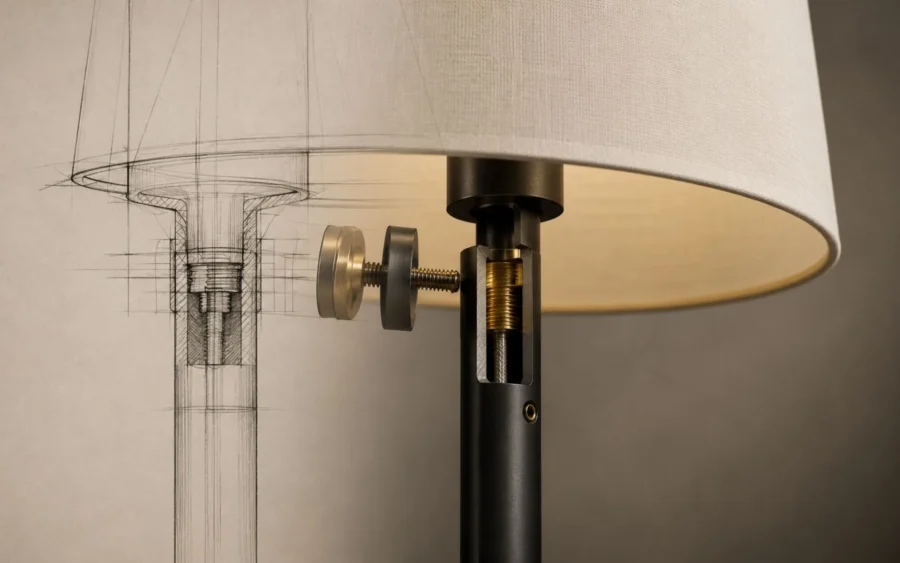
Why is the connection often more difficult to design than the lamp itself?
• A lamp is easy to draw. The connection is where the drawing must become the product.
In a sketch, the tube and shade may meet in one clean line. In the workshop, that line must bear weight, remain straight, pass through the cable, withstand assembly, and still allow for the lamp to be opened and repaired one day. This is why the design of the joint on a lamp often requires more thought than its basic form.
This is not a particularly photogenic part of the process. The joint is rarely the main focus of the presentation, and under a good lamp we may not even notice it. However, it is there that we can quickly see whether the product is just beautifully conceived or has been truly thought out.
In the drawing, a junction is just the meeting of two lines.
Let’s imagine a simple table lamp: a metal tube supports a textile shade. In the drawing, everything seems almost solved. But as soon as we move towards the prototype, questions arise that the sketch easily glosses over.
How do I prevent the shade from rotating? How large does the contact surface need to be to prevent it from wobbling? Can the screw be tightened without damaging the finish? Where does the cable run and does it touch a sharp edge? Can the shade be removed without disassembling half the lamp?
A millimeter in such a detail is sometimes more noticeable than a centimeter in the overall height of the lamp. If the joint is off-axis, the entire lamp looks crooked. If it is too big, it looks rough. If it is too small, it may not take the load well.
Therefore, the joint is not just the technical completion of the form. It determines whether the form will even look as it was drawn.
A good connection simultaneously carries, hides and allows access
The most demanding joints must solve several conflicting requirements. They need to be strong, but not bulky. They need to hide the technology, but not permanently seal the product. They need to allow for easy assembly, but not look like they were created just to make production easier.
Carrying capacity is not visible until it is gone.
A lampshade, glass or metal element creates its own weight and leverage. The wider the part and the further away from the support, the greater the torque the connection must absorb. It is therefore not enough to ask whether the screw can “hold”. It is also important to which surface the force is transmitted, whether the connection can loosen over time and what happens when someone picks up the lamp by a part that is not intended as a handle.
Safety requirements for luminaires do not separate aesthetics from construction: the current IEC 60598-1:2024 standard covers both mechanical and electrical construction, and among the changes specifically lists requirements related to serviceable and non-serviceable components.
In other words, the way the parts are put together is not a footnote to the design.
A hidden screw is not automatically a better screw.
It is often assumed that the best connection is the one that is not visible. This is only true if hiding it does not create a bigger problem.
A screw hidden deep in a pipe may look elegant, but if it can only be accessed with a special tool, at an awkward angle, or after removing electrical parts, visual cleanliness is paid for by poor service.
Sometimes a precisely placed and well-finished visible screw is a more honest solution than a completely hidden mechanism. It can become part of the rhythm of the product, especially if it follows the axis of the lamp, repeats the finish of other metal elements and does not look like an afterthought.
Our position is simple: the screw itself is not an aesthetic problem; the problem is the screw that is clearly not part of the design decision.
Servicing is planned before the first service
With a lamp, it’s not enough to predict how it will be put together the first time. You also need to think about the reverse order: how it will be opened after a few years, what comes off first, whether the socket or control component can be accessed, and whether disassembly will permanently damage the paint, cable, or shade.
It is no longer just a matter of good will on the part of the manufacturer. The EU Ecodesign Regulation for light sources and separate ballasts requires that in covered products these parts can be replaced with common tools and without permanent damage to the product, unless there is a documented technical justification. This is clearly stated in Article 4 of Regulation (EU) 2019/2020 .
The regulation, of course, doesn’t tell the designer exactly where to place each screw. But it confirms an important direction: a product shouldn’t become waste just because someone made a technical part inaccessible.
A prototype reveals what a render cannot
In the render, all the parts are perfectly aligned, the materials have no tolerances, and the assembly happens without hands or tools. The prototype brings reality back into the project.
Only then can you see whether the joint can be tightened without turning the entire pipe, whether the tool leaves a mark on the surface, whether the joint casts an unwanted shadow, and whether there is enough room for your fingers.
Sometimes the solution that looks the cleanest on the screen requires three hands in practice. The second, only slightly more visible solution, is assembled calmly, repeatably and without improvisation.
In custom manufacturing, this is especially important because the dimensions, materials and method of assembly change from project to project. Experience does not serve to automatically repeat the same connection on every lamp, but to recognize earlier where the problem could arise.
That’s why serious development often includes a test piece, checking the assembly sequence, and correcting details that seem unimportant in the initial drawing.
We have already written about subsequent interventions on the finished product in the text Can lamps ordered and completed at Corda Lighting be further processed? . However, it is better to foresee the possibility of adjustment and repair in the construction than to save it later by improvising.
The seriousness of the product lies in the detail
When the connection works well, the user probably won’t praise it much. The lamp will simply be flat, stable, neat, and logical to maintain. That’s perhaps the best compliment to such a detail.
In lighting design, form attracts the first glance, but the construction determines whether the product will withstand that gaze. That’s why the seriousness of a lamp is not measured by the number of hidden screws, but by the quality of the decisions that placed them exactly where they should be.
Sources
IEC 60598-1:2024 — Luminaires, Part 1: General requirements and tests
We are happy to answer all your questions!
Use the form below and ask anything you want to know.
If you need an official offer, choose: company