Lamp restoration or reproduction: how to make the right decision
25. August 2026.
A LOOK INTO THE PAST The first Euroluce in 1976: when lighting got its own big stage
25. August 2026.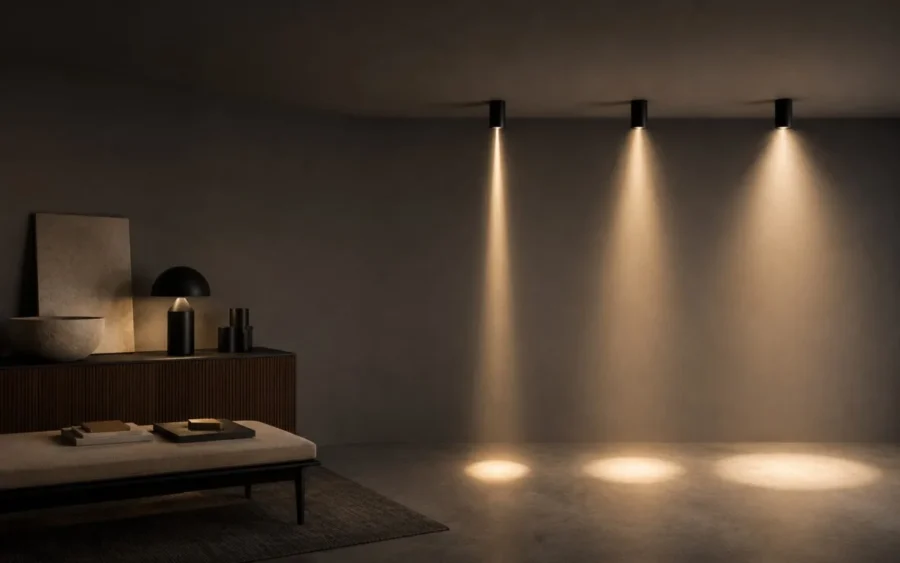
Light beam angle: how to choose the right one?
When choosing lighting, we most often look at the power, number of lumens, color temperature, and appearance of the lamp. However, another piece of information has a strong influence on the final result: the angle of the light beam.
Two lamps can have the same number of lumens and the same color temperature, yet illuminate a space completely differently. One will create a small, intense circle of light, while the other will spread the same amount of light over a much larger area. The difference is in the way the lamp directs the light.
Therefore, the number of lumens by itself is not sufficient to assess whether a particular lamp will suit the space and purpose.
What is the angle of the light beam?
The beam angle describes the width within which a lamp directs the majority of its light. It is expressed in degrees, for example 15°, 24°, 36° or 60°.
A smaller angle means a narrower and more concentrated beam. A larger angle means a wider spread of light.
With a narrow beam, the light is focused on a smaller area, so the illuminated object or part of the space appears more emphasized. With a wide beam, the same amount of light is distributed over a larger area, making the transition between the illuminated and unilluminated part of the space smoother.
The angle doesn’t tell you how much total light the source produces. It tells you how that light is distributed.
Narrow, medium or wide beam?
The names and boundaries of individual categories may differ between manufacturers. However, for easier understanding, we can use an approximate division:
| Beam angle | Character of light | Common application |
|---|---|---|
| up to approximately 20° | very narrow and concentrated | works of art, details, smaller exhibition items |
| from 20° to 40° | narrow to medium beam | tables, shelves, decorative elements, accent lighting |
| from 40° to 60° | medium-wide beam | work surfaces, communication zones, more even accents |
| more than 60° | wide diffused light | general lighting and illumination of larger areas |
These values are not a universal rule. The result is also affected by the shape of the reflector, the type of lens, the position of the light source, the mounting height, and the way the intensity decreases towards the edges of the beam.
Therefore, two lamps marked with the same angle do not have to leave exactly the same light trail on the surface.
Why doesn’t the same number of lumens mean the same brightness?
Lumens describe the total amount of light emitted by a source. Lux, on the other hand, describes how much light falls on a given surface.
Imagine two 1,000 lumen lamps placed at the same height. The first has a narrow beam angle, the second a wide beam angle.
A narrower lamp will concentrate most of its lumens on a small area. Therefore, we can expect higher brightness and more pronounced contrast in the center of the beam compared to the surroundings. A wider lamp will distribute the light over a larger area, so the illumination will be more uniform, but less intense in the center.
This does not mean that one lamp is better than another. They have different purposes.
A narrow beam can be great for highlighting a sculpture, painting, or wall texture. However, the same beam as the only light in a room could create excessive contrast and large dark areas. A wide beam may be more suitable for general lighting, but it won’t necessarily highlight a small object or architectural detail.
How does the installation height change the light circle?
The further the lamp is from the surface, the larger the light circle becomes. At the same time, the light is distributed over a larger area, so the illumination decreases.
The diameter of the approximate light circle can be estimated using the beam angle and the distance between the lamp and the surface.
For example, if the lamp is two meters from the surface:
- a 15° beam creates a circle with a diameter of approximately 0.5 meters
- a 36° beam creates a circle with a diameter of approximately 1.3 meters
- a 60° beam creates a circle with a diameter of approximately 2.3 meters
The same angle will therefore not give the same result in a space with a 2.6-meter-high ceiling and in a five-meter-high hotel lobby.
Mounting height and beam angle should always be considered together.
Which angle should you choose for each purpose?
Accent lighting
A narrower beam is most often used to highlight a work of art, plant, product or wall texture. It directs attention to the selected element and creates a difference between it and the background.
Make sure that the beam is appropriate for the size of the object. If it is too narrow, part of the object will remain outside the illuminated zone. If it is too wide, the light will cover a large part of the wall and weaken the desired contrast.
Lighting above the table
Above a dining, restaurant or work table, the light beam should match the dimensions of the surface and the height of the lamp.
A beam that is too narrow can illuminate the center of the table strongly, while the edges remain dark. A beam that is too wide can unnecessarily illuminate the surroundings or create an uncomfortable light in the eyes of the people sitting at the table.
In addition to the beam angle, the position of the source, the depth of the shade, and protection from looking directly into the bulb or LED module are important here.
General lighting
To evenly illuminate a larger space, wider beams or a combination of multiple lamps whose beams partially overlap are generally used.
The spacing between the lights is important. If it is too large, there may be noticeably lighter and darker zones on the floor and work surfaces. If it is too small, certain parts of the space may be unnecessarily brightly lit.
Sales and exhibition spaces
In shops, galleries and showrooms, several corners are often combined. A wider beam provides basic visibility, while narrower beams direct attention to products or key display elements.
The angle of the light beam here becomes part of the visual hierarchy of the space: the light shows the visitor where to look.
The most common mistakes when choosing
Even when a quality lamp is selected, good results may not be achieved. The most common reasons are:
- selection only by power or number of lumens
- ignoring the height at which the lamp will be placed
- using one corner for all functions in the space
- mismatch between the size of the beam and the illuminated object
- too much distance between lamps
- placing a directional source so that it creates glare
- the expectation that a decorative lamp will provide all the necessary lighting on its own
It is particularly important to distinguish the decorative appearance of a lamp from its actual lighting effect. The shape of a lamp may look simple, but the construction of the lampshade, the position of the light source and the treatment of the inner surface determine where the light will be directed.
It’s not just the angle that matters, but the entire light distribution.
The angle information is a good start, but it does not describe all the characteristics of the lamp.
Good planning also involves looking at photometric data, which shows how the light intensity changes in different directions. It is important to see whether the beam has a clearly defined edge or a smooth transition, whether it is symmetrical, and how much light spills out beyond its main area.
The final experience is further influenced by:
- color and reflection of the walls, floor and ceiling
- illuminated surface texture
- temperature and color reproduction quality
- dimming capability
- observer position
- the presence of other light sources
That’s why lighting shouldn’t be chosen as a series of unrelated products. Each lamp has its own role, and the angle of the light beam is one of the data points that determines that role.
A small piece of information with a big impact
The angle of the light beam is often written as a small number in the technical data, but its impact in space is very visible.
It determines whether the light will precisely highlight a detail, evenly cover a work surface or diffuse throughout the entire room. Together with the lumens, mounting height and position of the lamp, it determines the actual illumination and atmosphere of the room.
Well-planned lighting therefore does not begin with the question of which lamp is the most powerful, but rather with the question of what we want to illuminate, from what distance and in what way.
When a standard solution cannot achieve the desired distribution, dimensions or visual character, the luminaire can be adapted to the specific space. Corda Lighting develops and manufactures lighting according to interior requirements, from the first technical consideration to the final execution.
We are happy to answer all your questions!
Use the form below and ask anything you want to know.
If you need an official offer, choose: company