Why is the connection often more difficult to design than the lamp itself?
25. August 2026.
Light beam angle: how to choose the right one?
25. August 2026.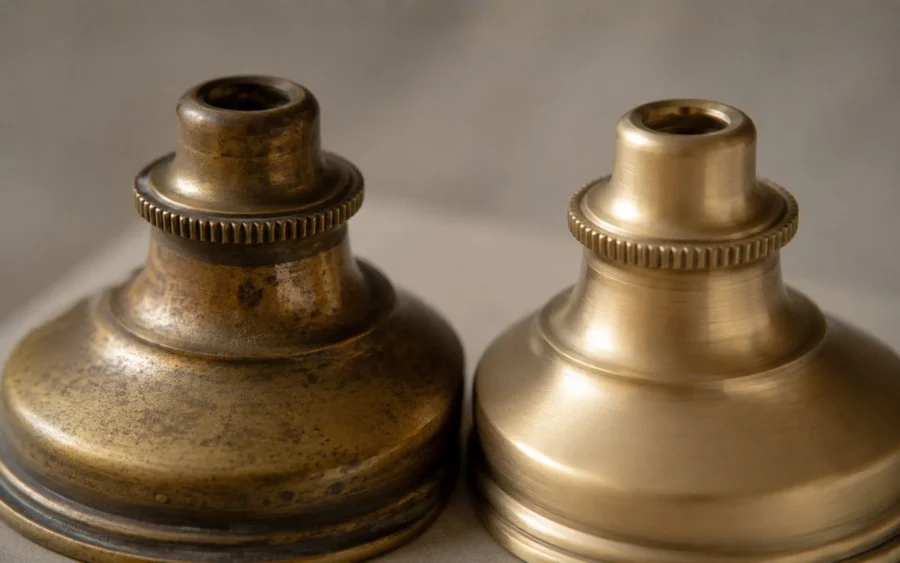
Lamp restoration or reproduction: how to make the right decision
An old lamp can have a high market value, be an important part of the decor or simply carry a family story. When it is missing a shade, the electrical parts are no longer safe or the structure is seriously damaged, the question arises: should it be restored or a reproduction made from it?
The answer doesn’t just depend on what’s cheaper. It’s important to determine how much of the original has been preserved, whether the lamp can be safely reused, and whether the intervention would preserve its character or irreversibly erase it.
What does lamp restoration actually mean?
In everyday speech, we often refer to any modification of an old lamp as restoration. However, serious lamp restoration is not the same as a quick polishing, repainting, or replacing all the old parts with new ones.
The goal of restoration is to preserve as much of the original object as possible. Interventions are therefore planned after examining the structure, materials, joints, surface treatment and electrical components. What is needed is repaired, and parts that can be preserved are not replaced just because they no longer look like new.
This approach is especially important for lamps that have:
- recognizable authorship or manufacturer
- rare or documented performance
- high-quality cast, forged or hand-machined parts
- original glass, textiles, ceramics or finishing
- personal, family or historical value
A restored lamp doesn’t have to look like it just left the factory. Traces of time can be part of its identity.
Patina is not always damage
One of the most common mistakes when restoring old lighting is assuming that the metal has to be completely shiny again. Patina, tarnish, and minor signs of wear are sometimes a desirable part of the look, not a stain that needs to be removed.
The Canadian Conservation Institute warns that polishing metal is abrasive: along with the tarnish, part of the original surface is always removed. Thin galvanised layers, lacquered brass and artificially patinated metals are particularly susceptible. Aggressive cleaning can remove the very finish that makes an object valuable.
Therefore, before the procedure, they need to differentiate:
- surface dust and grease
- stable patina
- original paint or varnish
- active corrosion that continues to damage the metal
- later coatings that are not part of the original lamp
When the origin of a layer is unclear, it is safer to first document and examine a smaller, inconspicuous area than to immediately sand the entire object.
Electrical parts require a separate assessment.
An old lamp may be visually preserved, but still unsafe to use. A cable with cracked insulation, a loose neck, traces of overheating, inadequate grounding or improvised connections are not aesthetic defects, but safety risks.
It is therefore important to separate the two types of value. The metal body, glass or shade may be original and worth preserving, while the cable, socket and other electrical elements may require professional replacement. Limited and careful modernization of the electrical system is not contrary to restoration if it is carried out in a way that preserves the character and valuable parts of the object.
The lamp should not be turned on if there are any visible damaged wires, signs of burning or heating, nor should electrical repairs be turned into a home experiment. After the procedure, it must be suitable for its purpose and the conditions of the space in which it will be used.
When is reproduction a better choice?
A reproduction is a new lighting fixture made from a preserved original, photograph, blueprint, or other reliable data. It does not preserve the original object, but recreates its shape, proportions, and character.
This may be a more sensible solution when:
- The original lamp no longer exists, but there are good quality photos or drawings.
- The preserved specimen is so damaged that it does not have a sufficiently stable structure for safe return to use.
- The original is valuable and should be preserved, but the space needs more identical lamps.
- A large number of decorative or structural elements are missing that cannot be reliably replaced by individual repairs.
- A historic interior requires visually coordinated lighting, and there are not enough original examples.
Good reproduction is not achieved by guessing. The more reliable information there is about dimensions, materials, joints, finishes and light scattering, the more faithful the result can be.
Restoration and reproduction are not opposite decisions
In some projects, the best solution involves both approaches. One valuable original can be restored and preserved in a prominent location, while reproductions are made for other positions. This way, the historical object is not exposed to unnecessary wear and tear, and the space maintains a consistent visual language.
| Question | The restaurant has priority. | Reproduction has priority |
|---|---|---|
| How many originals have been preserved? | Most of the important parts are there | The original does not exist or is badly damaged. |
| What is the main value? | Authenticity, authorship and the trace of time | Shape, proportions and role in space |
| How many copies are needed? | One or several preserved pieces | A larger number of identical lamps |
| Can it be used safely? | Careful electrical renovation is possible | The structure cannot be reliably returned to service. |
| Is there documentation? | The subject itself provides enough information | There are drawings, photos or a sample for making |
| How many changes are needed? | The intervention may remain limited. | Most parts would have to be re-made |
Five questions before making a decision
Before ordering a procedure, it is useful to gather basic information and not do anything that could remove clues important for the assessment.
- Is there a manufacturer’s mark, signature, sticker, or serial number?
- Which parts are definitely original, and which have been changed over the years?
- Is the goal to preserve the item, reuse it on a daily basis, or furnish a larger space?
- Are there old photographs, blueprints, or other copies of the same thing?
- Can the procedure be performed without aggressive sanding, drilling and removal of original details?
Before disassembling, it is a good idea to take photos of the lamp from multiple angles, record the dimensions, and save all the separate elements. Even a broken piece of glass, an old screw, or a piece of fabric can be an important template for repairing or making a replacement part.
The right decision starts with understanding the subject
Restoration of a lamp makes sense when there is still enough original material worth preserving and when functionality can be restored with careful, limited intervention. A reproduction is a fairer solution when the original is missing, when a large number of identical pieces are needed, or when an attempt at restoration would actually mean replacing almost the entire lamp.
In both cases, the best result does not begin with the tools, but with inspection and documentation. Experience in lighting design helps to understand how the structure, material, electrical components and character of the light are connected. It is this whole that should guide the decision about what to preserve, what to safely restore and what to re-create.
Sources
We are happy to answer all your questions!
Use the form below and ask anything you want to know.
If you need an official offer, choose: company