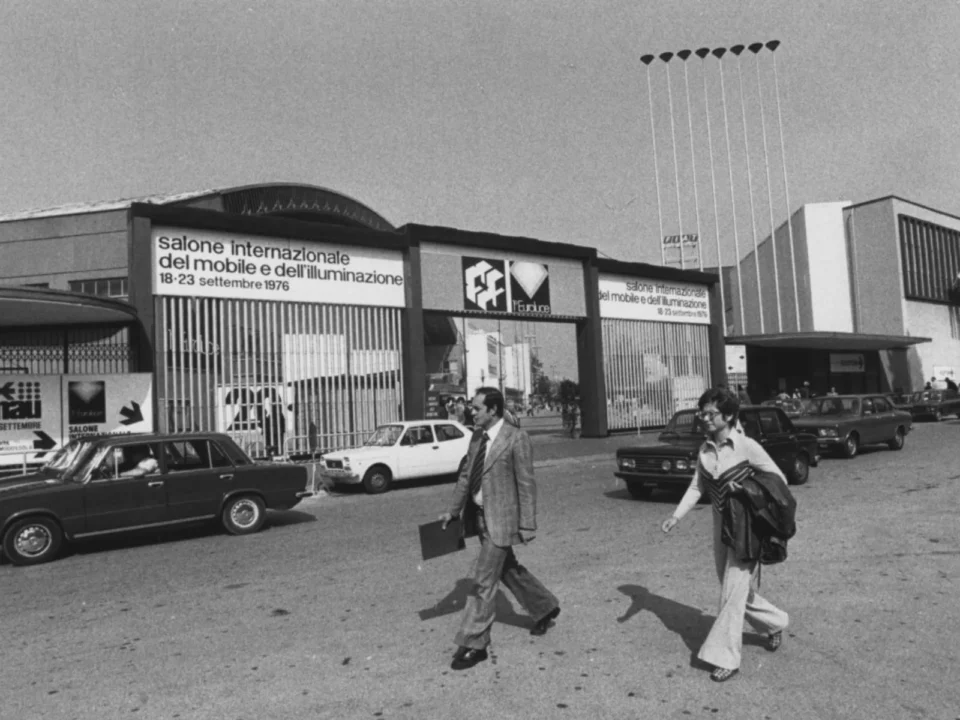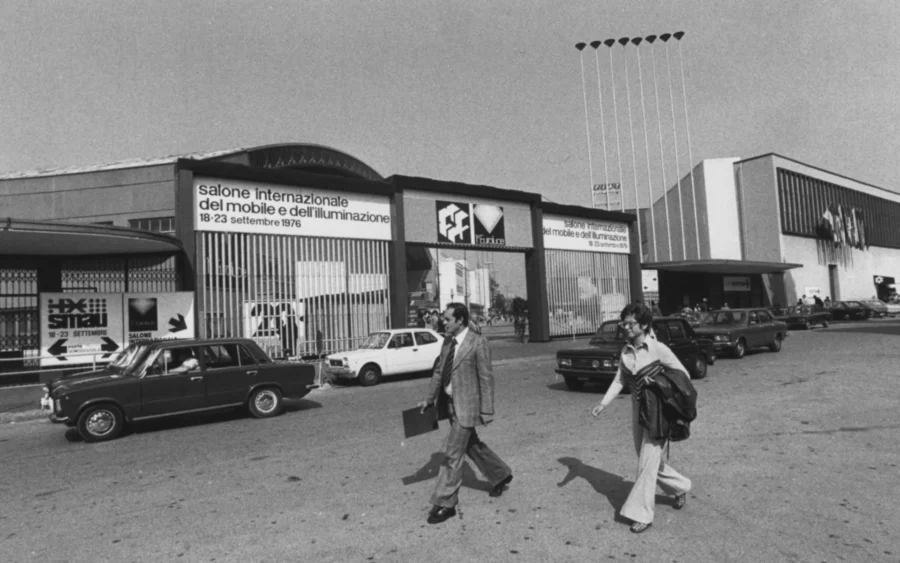
A LOOK INTO THE PAST The first Euroluce in 1976: when lighting got its own big stage
25. August 2026.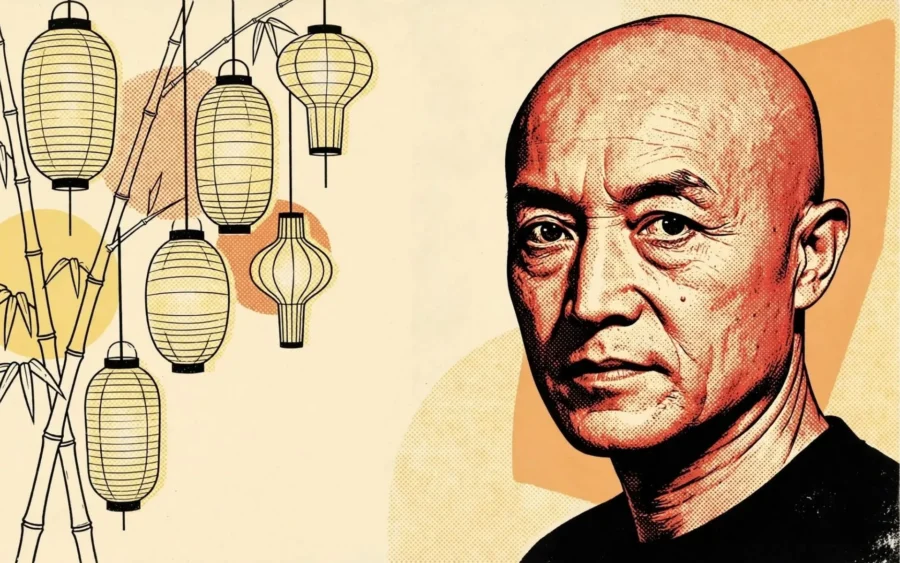
PORTRAIT OF AN ICON Isamu Noguchi, the sculptor who turned paper into light
In the spring of 1951, Isamu Noguchi arrived in Gifu, a Japanese city with a long tradition of paper lantern making. There, while fishing at night, he watched boats illuminated by chochin lanterns. The scene was old, almost ritualistic: candle, paper, bamboo, and light on the river. Noguchi, however, saw it not as an object to be preserved under glass, but as a craft that could live on.
The mayor of Gifu suggested that he help the local lantern industry, which was then in decline. Noguchi accepted and made a seemingly simple change. He replaced the candle with an electric bulb. Everything that followed showed that a simple change in source could open up a whole new question: is this still a lantern, a lamp, or a sculpture?
He called them Akari , a word that means light in Japanese, but also carries the idea of lightness. Seventy-five years later, the answer is still not completely clear. That is why Akari still seems contemporary.
Isamu Noguchi did not design a lamp, but a light sculpture
Noguchi was born in 1904 in Los Angeles, grew up between the United States and Japan, and throughout his life worked in stone, wood, metal, ceramics, and space. He designed sculptures, gardens, public spaces, stage sets, furniture, and playgrounds. The division into art and design was not particularly useful to him. An object in use could still be a sculpture, and a sculpture did not have to live only on a pedestal in a museum.
Akari is perhaps the clearest expression of this thinking. Noguchi did not call them lamps, but light sculptures. This was not a poetic quip added to the finished product. When turned off, Akari is a light volume of paper and thin ribs. When turned on, the source is no longer just in the object: the light reveals its construction, softens the edges and changes the space around it.
Before the Akari collection, Noguchi had already explored sculptures with built-in artificial light. According to the archives of the Museum of Modern Art in New York , in the 1940s he worked with materials that allowed him to place the source within the form. In Gifu, he found a different answer. He didn’t need a new industrial material. He needed a craft that already knew how to transform a thin surface into a carrier of light.
The paper here is not a decoration around the light bulb.
The Akari were created in collaboration with the family-run Ozeki workshop, which has been making traditional lanterns since the late 19th century. Thin bamboo slats were placed over wooden molds, and then handmade washi paper was glued on. Once the structure had dried, the mold was removed, leaving behind a lightweight, foldable volume.
There aren’t many parts in this construction:
- washi paper diffuses light and hides a direct view of the source
- bamboo ribs maintain volume but remain visible through the illuminated surface
- metal or wooden structure provides support for floor and table models
- electric bulb introduces a traditional lantern into a contemporary interior
The list is short, but the effect is not. The paper does not only serve to make the bulb less visible. Its fibers, irregularities and warmth become part of the light image. The bamboo is not hidden as a technical necessity, but creates a rhythm on the surface. The structure and the light are read together.
There is also an important distinction between thin material and a weak product. The Akari look fragile, but their lightness is not a flaw that needs to be hidden. It is the basic idea. The lamp can be folded, carried, and opened again, while taking up a volume in space that would appear completely different in a heavier material.
| Noguchi’s decision | Effect in space |
|---|---|
| Thin surface of washi paper | The light becomes softer and the large volume remains visually light. |
| Visible bamboo ribs | The construction provides rhythm instead of disappearing behind the cladding |
| Source within the form | The object not only illuminates its surroundings, but also itself. |
| Irregular, sculptural shapes | The lamp remains on even when it is not turned on |
More than a hundred responses to the same material
Noguchi did not stop at one recognizable paper ball. Over the decades, he created more than a hundred Akari models: low tabletop forms, elongated floor lamps, hanging volumes, and large, almost unstable sculptures on thin metal legs. The Noguchi Museum states that he continued his collaboration with the Ozeki workshop until the end of his career.
The variety of these models shows how far one can go without constantly changing the basic material. Industrial design often proves its novelty with a new technology, a more complex mechanism, or a material that did not exist before. Noguchi did something more sedate. He took a familiar technique and tested for a long time how many different forms and relationships to space it could handle.
Therefore, Akari is not a modernization of tradition in the sense that the old was to be made less old. The traditional process remained visible and important. The modernity came from the way Noguchi placed it in a new context: from a fishing lantern to a living room, from a local craft to an international design culture, from a utilitarian object to a series of sculptures that are produced and used.
Why Akari hasn’t aged after 75 years
Anniversaries alone do not prove their value. Many objects have reached great age without anyone wanting to use them anymore. Akari are interesting because they are not just a document of a period. They are still produced in Gifu, and original examples are in museum collections such as MoMA . The Noguchi Museum is celebrating their 75th anniversary in 2026.
The reason for their longevity may be that they don’t try to hide the time they come from. They show the handiwork. The construction shows. Paper will change color over time and is sensitive to moisture, dirt, and rough handling. These are not insignificant weaknesses. They are inherent to the material and require us to treat the object differently than we would a lamp made of metal or glass.
At the same time, Akari does not depend on a single interior fashion. Their form can be geometric or organic, restrained or unusual, but the lighting principle remains understandable: the source is hidden, a large surface is illuminated, and the object gives the space both light and presence.
The material does not surround the light, but shapes it.
In lighting, the lampshade is sometimes seen as the final garment of a structure. First there is the lamp, then its shape, color, or fabric are chosen. Noguchi’s work shows why this order is often wrong. If we remove the paper from the Akari lamp, we have not changed the decoration. The very idea of the product has disappeared.
This is true outside of his work as well. Textiles, paper, glass, metal or some other material do not only determine how a lamp looks when it is turned off. They determine how much light it will let in, where it will be directed, what it will hide and what kind of mark it will leave on the surrounding surfaces. Shape and material cannot therefore be seriously chosen separately from the lighting effect.
75 years ago, Noguchi found a paper lantern on a boat in Gifu. He did not take away its craft to turn it into a modern product. He recognized that precisely in that craft he already found what he was looking for: a structure light enough for light to become its main material.
Akari have survived decades because we can still see that initial scene in them. Paper, bamboo and a light bulb are not much. In the right proportions, Noguchi showed, they are enough to illuminate a space and at the same time change it.