Artificial sky in the interior: an ingenious solution or an expensive trick?
5. May 2026.
How to properly light a mirror and avoid the most common mistakes
19. May 2026.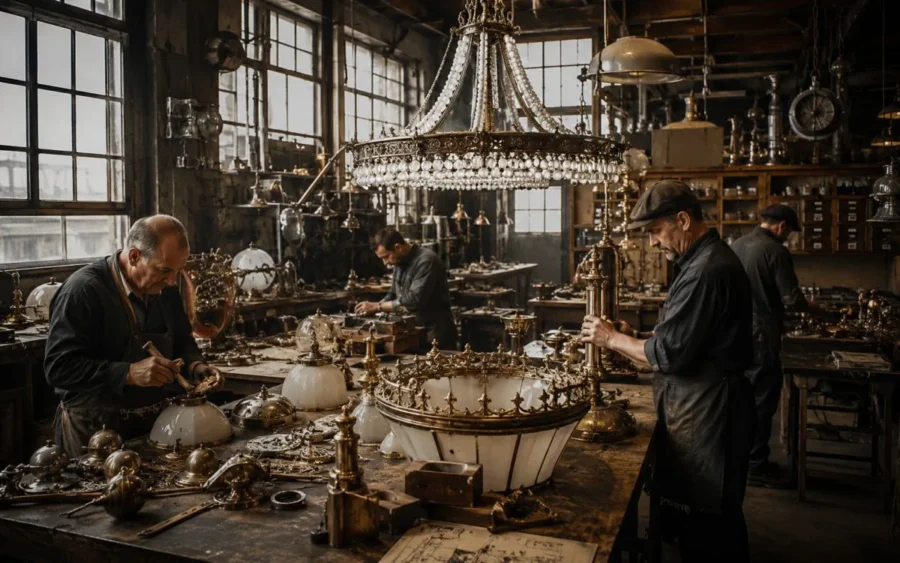
A LOOK INTO THE PAST
When hotels had their own light smiths
Today, it is quite normal to open a catalog, choose a lamp model, and wait for delivery. However, in the late 19th and early 20th centuries, many hotels did not purchase lighting in this way. Large hotels often had specially designed chandeliers, wall lamps, and light fixtures made specifically for their space. Lighting was then part of the hotel’s identity, just as important as the architecture, furniture, or the view from the room.
A time when lighting didn’t come from a catalog
In luxury hotels in Vienna, Paris, Budapest, or on the Adriatic coast, lighting was made by hand. Locksmiths, glaziers, blacksmiths, turners, and electricians participated in the projects. The term “ bespoke lighting ” as we know it today did not exist, but that is exactly what was done. The light was adapted to the space, the atmosphere, and the guests who passed through it.
Hotels back then wanted to give the impression of luxury and warmth. Large chandeliers in the lobbies were not just for lighting. They were a symbol of status, modernity, and hospitality. At a time when electricity was not yet the everyday thing we know today, impressive lighting was also a kind of demonstration of technological progress.
Handicraft behind every chandelier
Making hotel lighting used to be a serious craft. Large pieces took weeks or months to produce, and every detail was handled by a master craftsman. Special attention was paid to the processing of metal, the quality of the glass, and the way the light fell across the space.
Materials that shaped the atmosphere
The most commonly used were:
- brass
- copper
- wrought iron
- frosted or opal glass
- crystalline elements
- hand-finished wood
Such materials were not chosen just for their appearance. They determined the way light was reflected and spread. The warmth of brass or the softness of opal glass created an atmosphere that many hotels still try to recreate today.
Light as part of architecture
Today, lighting is often viewed as a separate product. It used to be part of the building itself. Architects and craftsmen worked together to plan where chandeliers would be placed, how they would illuminate staircases, or how they would emphasize the height of a space.
In many old hotels, it was the lighting that was most memorable to guests. A large chandelier in the lobby or a warmly lit restaurant left an emotional impression that was just as important as the hotel’s service.
What can today’s bespoke lighting learn from the past?
Even though modern LED technology and advanced lighting control systems exist today, many designers are returning to the principles of the past. More and more hotels are looking for custom lighting that gives a space personality instead of a universal look from a catalog.
That is why in recent years interest has been resurgent in:
- handmade lamps
- natural materials
- unique chandeliers
- lighting adapted to the architecture of the space
- a combination of modern technology and traditional craftsmanship
Good hotel lighting has never been just about lumens. It has always been about feeling. Guests may not remember the technical specifications of a lamp, but they will remember how they felt in the space.
Then and now, access to hotel lighting
| Before | Now |
|---|---|
| Handmade lighting | Serial production |
| Hotel-specific lighting | Universal models from the catalog |
| Natural materials and metal | Frequent use of plastics and composites |
| Long-lasting and repairable products | Faster product replacement |
| Focus on the atmosphere of the space | Focus on functionality and price |
| Collaboration between craftsmen and architects | Standardized systems |
Return to the identity of space
Perhaps that’s why there’s a renewed interest in bespoke lighting today. In a time when many interiors are starting to look similar, hotels are looking for a way to make their own signature. And lighting is often the first step towards that.
The former “lightsmiths” may no longer exist under that name, but the idea behind their work is still alive. Light is not just a technical solution. It shapes the atmosphere, emotion, and identity of a space.
And perhaps this is precisely the biggest lesson that old hotels leave us behind.
We are happy to answer all your questions!
Use the form below and ask anything you want to know.
If you need an official offer, choose: company