Why does a new light bulb never look the same as an old one, even though it says 3000K?
28. April 2026.
A LOOK INTO THE PAST When hotels had their own lightsmiths
12. May 2026.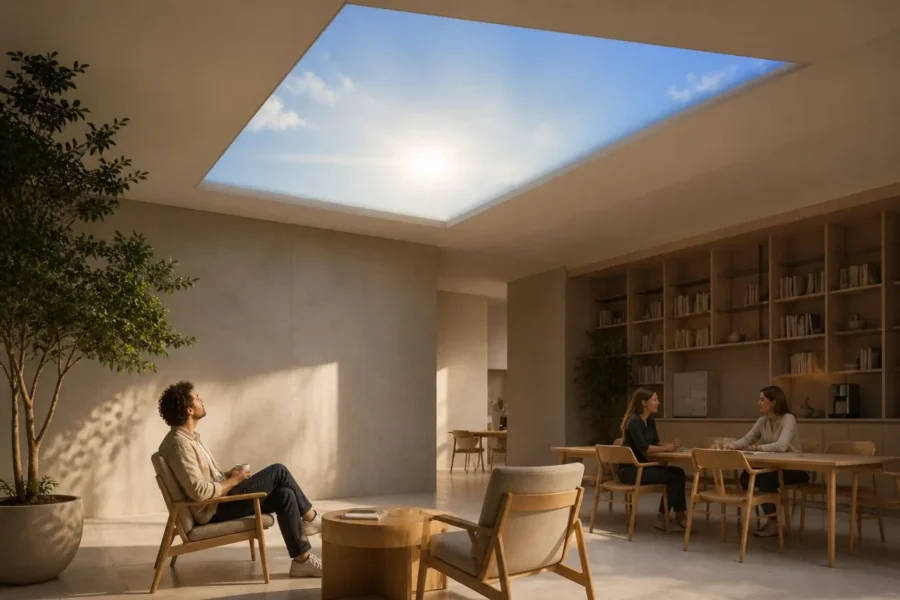
Artificial sky in the interior: an ingenious solution or an expensive trick?
In recent years, we have increasingly seen solutions that promise something previously impossible: bringing natural light where there is none. Technologies like CoeLux panels create the illusion of a real sky, a sunlit space, and a depth that feels almost real. In basements, windowless hallways, or medical facilities, this sounds like the perfect solution.
But once we get past the initial “wow” impression, we come to the real question. Is this really the future of lighting or just a highly sophisticated illusion that has its limits?
The benefits of an artificial sky that are hard to ignore
The greatest value of such systems is the psychological effect. People are used to natural light and a space that “breathes”. When the illusion of the sky is introduced into a closed space, the perception of space changes. The ceiling is no longer a boundary, but an opening.
In spaces without daylight, such as hospitals, wellness areas, or deep office spaces, this can have a real impact on the feeling of well-being. Companies like Sky Factory and Innerscene are taking this concept further through circadian lighting and changing light throughout the day.
Another advantage is design clarity. Such a panel often solves the entire space in one go. You no longer need to think about layers of lighting, ambient, and accent, because you have a central element that carries the entire story.
And third, technically speaking, these solutions can be very precise. The spectrum, direction of light, and intensity can be controlled at a level that, with traditional lamps, often requires multiple sources and more compromises.
Where does this kind of lighting start to lose its meaning?
Now comes the part that is often overlooked.
First, the price. These systems are not “lighting”, but a technological product. The investment is many times greater than traditional solutions, and installation requires planning, space, and often construction work.
Second, authenticity. No matter how good the illusion is, it is still an illusion. In a space where the user expects honest, material design, such a solution can act as scenery, not architecture.
Third, flexibility. Traditional lamps allow for layering, changes, and adjustments over time. The artificial sky is the central element that defines the space. Once you place it, everything else is subordinate to it.
And fourth, a matter of context. In a luxury hotel or clinic without windows, it makes sense. In a living room or restaurant with an existing identity, it often doesn’t.
Artificial sky vs. classic lighting
Classic lamps, especially in the custom version developed by Corda, do something else. They do not try to imitate nature, but create their own light identity of the space.
An artificial sky gives the illusion of the outside world. Classic lighting builds the inside world. One is not necessarily better than the other, but philosophically, they are completely different approaches. One hides the boundaries of space, the other emphasizes and shapes them.
That’s why the real question is always the same: not what is technologically possible, but what the space really needs.
We are happy to answer all your questions!
Use the form below and ask anything you want to know.
If you need an official offer, choose: company