Custom lighting: why spaces need custom-made light
16. June 2026.
OFFICE LIGHTING Is 500 lx really enough?
30. June 2026.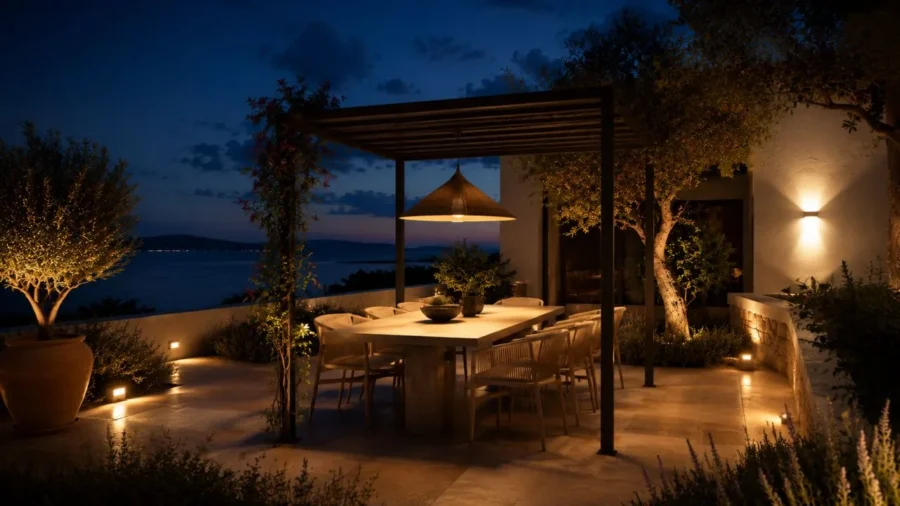
TERRACE LIGHTING
5 mistakes that make a space lose its atmosphere after sunset
A terrace can be carefully decorated, harmoniously connected to the interior and surrounded by greenery, and still lose all its character after sunset. The most common reason is not a lack of light, but lighting that has been chosen without a clear idea of what needs to be illuminated and what kind of experience you want to achieve.
Good lighting for a patio doesn’t mean that every part of the space has to be equally visible. Its role is to allow safe movement, create comfort at the table, and highlight details that give the patio depth. When everything is left to one bright light, the space often becomes flat, exposed, and less inviting than during the day.
Below, we highlight five mistakes that cause your outdoor space to not look as you intended in the evening.
1. One bright lamp tries to illuminate the entire terrace
The simplest solution is often to install a single powerful wall or ceiling light. This provides enough light, but it loses atmosphere. A single source creates harsh shadows, highlights only part of the space, and gives the impression that the terrace is lit primarily for safety.
Better results are achieved with layered lighting, or a combination of multiple sources with different tasks.
Three layers that give depth to the terrace
- Functional light allows for safe movement and use of the table, barbecue or summer kitchen.
- Ambient light creates a pleasant general atmosphere without excessive brightness.
- Accent lighting highlights greenery, wall texture, a column, pergola, or other selected detail.
Not all three layers need to be equally strong. It is the difference between the lighter and darker parts that creates the sense of depth that makes the terrace look attractive even after sunset.
2. The space is lit, but not what is being done on the terrace
When planning, we often think about where the electrical outlet is, and not enough about how the terrace is actually used. The result can be a lamp in the middle of the ceiling, while the table remains in shadow, the face of the person across the way is poorly visible, or the path to the entrance is not clear enough.
It is therefore more useful to plan lighting according to zones rather than according to available walls and ceilings.
| Terrace area | The main task of lighting | Appropriate approach | What to avoid |
|---|---|---|---|
| Dining table | Pleasantly illuminate the table surface and face | Pendant, wall or other directional light of appropriate height | Source at eye level and bright light directly in the face |
| Passages and stairs | Enable safe movement | Discreet wall, floor or low orientation lighting | Excessive brightness and sudden transitions from light to dark |
| Rest area | Create a calm and unobtrusive atmosphere | Indirect, table or floor ambient light | One cold and too bright ceiling lamp |
| Greenery and architecture | Give depth to the space and highlight selected details | A carefully directed accent source | Illuminate every plant and every wall with equal intensity |
When each zone is given its own lighting task, the terrace no longer looks like a single illuminated surface, but rather a thoughtful extension of the interior.
3. The light source is visible and creates glare
A lamp can be beautiful, but its light can still be unpleasant. If the source is visible from a sitting position or if it is placed too high and directed towards the eyes, glare occurs. Then we instinctively squint, turn our heads or choose a place further away from the lamp.
This is especially important on smaller terraces, where people are close to wall and ceiling sources. A more pleasant solution can be achieved:
- a shade or diffuser that blocks the direct view of the source
- by directing the light towards the table, wall or ceiling of the pergola
- the correct height of the lamp
- with multiple weaker sources instead of one very strong one
- with the possibility of dimming when the space has multiple uses.
The goal is not to hide every light fixture. Decorative lighting can be an important part of a patio’s identity, but its form and placement must match the way the space is used.
4. Terrace lighting is chosen solely based on appearance
An outdoor light is exposed to moisture, dust, temperature changes and other conditions that are not present indoors. Therefore, it is not enough for the design to match the furniture or facade. The construction, materials and degree of protection must match the exact location of installation.
The covered part of the terrace, the open wall along the edge of the roof and the lamp built into the floor are not equally exposed. The IP rating indicates the level of protection of the housing against the ingress of solid particles and water, but the required degree of protection depends on the position, method of installation and expected exposure. Therefore, the choice should not be reduced to one rating that supposedly applies to every terrace.
Before choosing, it is good to check:
- Is the lamp under a roof or completely open?
- Can it be directly exposed to rain or water jets?
- whether it is built into the wall, ceiling or floor
- how the material withstands sun, moisture and temperature changes
- whether the light source can be easily serviced or replaced later.
The right outdoor lighting must look good, but also function reliably in the conditions for which it is intended.
5. The decision is made without an evening rehearsal.
During the day, it’s hard to predict how light will behave. Wall color, shiny surfaces, glass walls, and dense greenery can completely change the result in the evening. Light can reflect off the window, create unexpected shadows, or leave an important part of the terrace too dark.
That’s why it’s useful to do a simple evening test run before making a final decision. A temporary light source can show whether the position of the lamp is appropriate, whether the source is distracting while sitting, and whether there is a good relationship between the table, aisle, and backdrop.
Questions worth asking during rehearsal
- Can we move around safely without feeling like the terrace is too brightly lit?
- Do we see people at a table without the light going directly into their eyes?
- Is there at least one illuminated detail that gives depth to the space?
- Is the source reflected in a window or glass opening?
- Can the atmosphere be adapted for an evening, socializing or lunch?
A small correction of position before installation often has a greater effect than subsequently increasing the power of the source.
Good lighting doesn’t show everything, but only what’s important.
Successful patio lighting doesn’t turn night into day. It guides the eye, facilitates movement, and creates a sense of comfort. The table needs enough light for dining, walkways need to be safe, and greenery and architecture can remain partially shaded to maintain depth.
The best result is not achieved by choosing a single lamp, but by considering the relationship between the source, position, direction and use of the space. When each element has a clear role, the terrace does not lose its character in the evening – it gains a new atmosphere.
We are happy to answer all your questions!
Use the form below and ask anything you want to know.
If you need an official offer, choose: company