
A LOOK INTO THE PAST How and when electric lighting arrived in Zagreb
19. August 2025.
Living room lighting: How to create the perfect atmosphere
2. September 2025.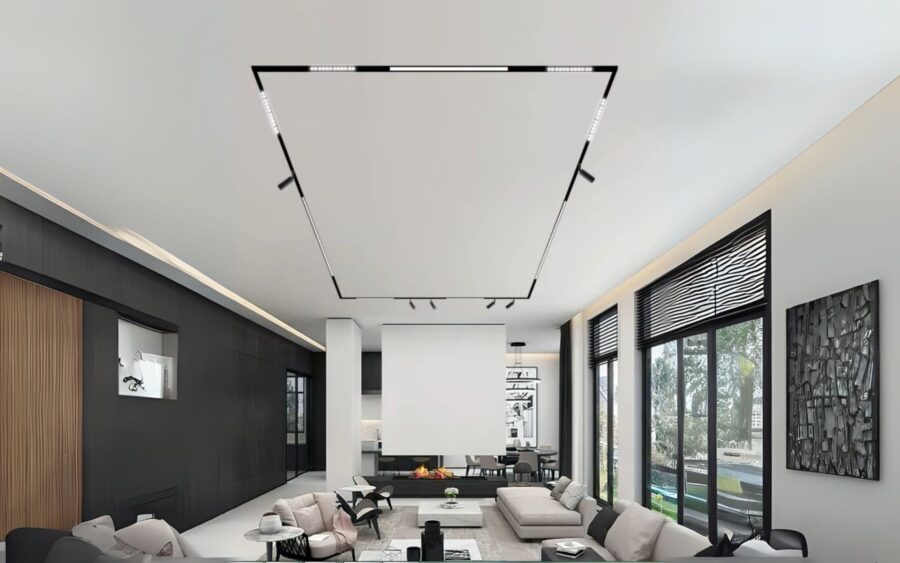
Why can a magnetic rail be a problem if you install it yourself?
When a customer thinks about built-in magnetic tracks, the most common question is: Is the installation something they can do themselves, or is it better to call an electrician? A built-in magnetic track consists of an aluminum profile, power supply, and connection points, and various light modules such as spotlights, linear, or pendants are later magnetically inserted into it. The idea itself seems simple and modular, but behind it lies a serious electrical lighting system.
The key thing to understand is that there are two separate parts to the job: the construction part, which involves cutting and preparing the slots and installing the track itself into the ceiling or wall, and the electrical part, which involves connecting to the mains voltage and testing. While the first part can be done by a skilled hobbyist, the second part should be left to a professional for safety reasons.
What can you do yourself?
The most challenging part of a built-in magnetic rail is to ensure that the profile is installed completely flat, flush with the surrounding surface. This means that a groove needs to be prepared in the Knauf or concrete ceiling, often with precisely cut lines so that the rail “fits” without visible deviations. This is followed by mechanical fixing of the profile using screws and brackets, and sometimes additional puttying or processing of the joints to make the final surface visually perfect. All of this can be done by a person with basic tools and some experience with interior work.
In addition, you can pre-route the cables to the point where the power supply will be connected, thus speeding up the electrician’s work. Of course, with this type of work, you need to pay attention to detail, because every uneven cut or crooked angle remains visible and disrupts the design of the entire space. If you like precise work and have a sense of aesthetics, you can successfully do this part yourself, saving on installation costs.
What should be left to an electrician?
The second part of the job is not only technically demanding but also legally sensitive. The built-in magnetic track is connected to a 230 V mains voltage, which means that it is handling installations that can be dangerous. The electrician will connect the driver, correctly distribute the phase, neutral and ground, and check that the system is protected by fuses and that everything is done according to standards. He also checks the continuity of the contact along the entire track and ensures that there is no risk of short circuit or overheating.
An incorrect connection can cause several problems: from flickering lights and interruptions to serious malfunctions or even fires. In addition, in commercial buildings, inspections often require proof that the electrical installation was carried out by a licensed electrician. That is why it is recommended that you do the aesthetic and construction part yourself, but the final connection and commissioning should always be in the hands of professionals. This way, you will get both safety and long-term functionality, and your built-in magnetic track will work without interference.
Main steps for installing a built-in magnetic rail:
- Position planning – determine where the rail will be placed and check if there is enough space for the driver and cable feed.
- Cutting the groove – prepare a groove in the Knauf or concrete into which the rail will sit; precision is key.
- Installing the rail – secure the aluminum profile using screws and brackets, and check that it is completely flat.
- Cable preparation – lead the installation cable to the location where the driver and power supply will be connected.
- Aesthetic finishing – if necessary, fill the edges, sand and level them so that the final surface looks neat.
- Electrical connection – the electrician connects the driver to the mains voltage, grounding, and checks for correctness.
- System testing – after connection, check if the rail is working and if all modules are stably connected.
We are happy to answer all your questions!
Use the form below and ask anything you want to know.
If you need an official offer, choose: company