Why hotels that want the “wow effect” don’t choose generic blinds
20. January 2026.
PALAIS HANSEN VIENNA How hotel blinds shape space without being imposing
3. February 2026.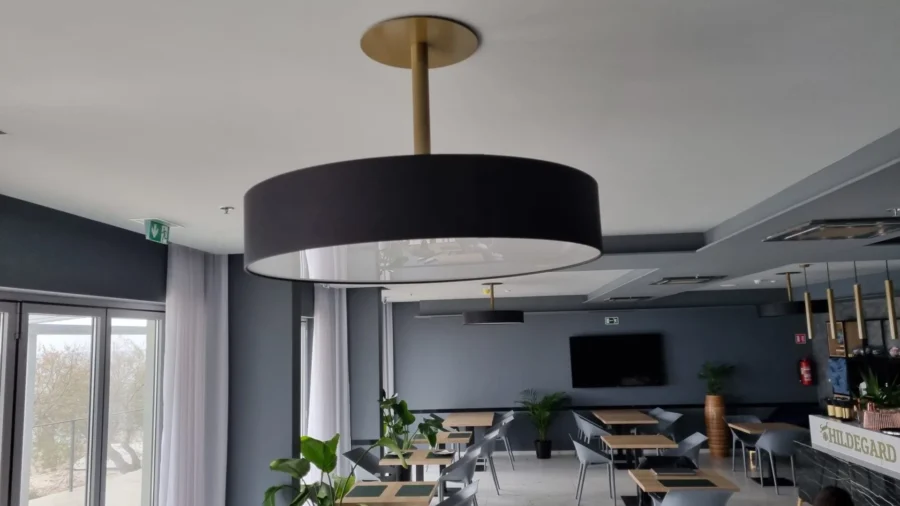
TRENDS 2026. Why lighting should no longer be just a “source of light”
If the past decade in lighting was marked by the question of “how many lumens”, then 2026 is undoubtedly the moment in which we ask ourselves, “what does that light say about the space and the person in it”. This is not a romantic phrase, but a very concrete shift that is clearly visible in the analysis provided by Houzz in its overview of trends for 2026. Lighting no longer acts as a technical infrastructure of the interior, but as an equal element of architecture and design, often as its carrier.
In this sense, most trends are not about “new shapes” but about changing priorities. Light is becoming less hidden and more visible. And not as decoration, but as an attitude.
The material is no longer neutral
One of the clearest shifts is the relationship to materials. Smooth, perfectly finished surfaces slowly give way to textures, traces of workmanship, and materials that are visible both under the fingers and under the light. Rough metals, visible joints, textile shades that are not “clean”, but alive, with fibers and irregularities.
Houzz describes it as a return to tactility, but there’s a broader point behind it. People are tired of interiors that look like renders. They’re looking for reality, imperfection, and the feeling that something was made, not thrown out of a machine. The light fixture becomes a testament to the process, not just the result.
Light as an object, not just a source
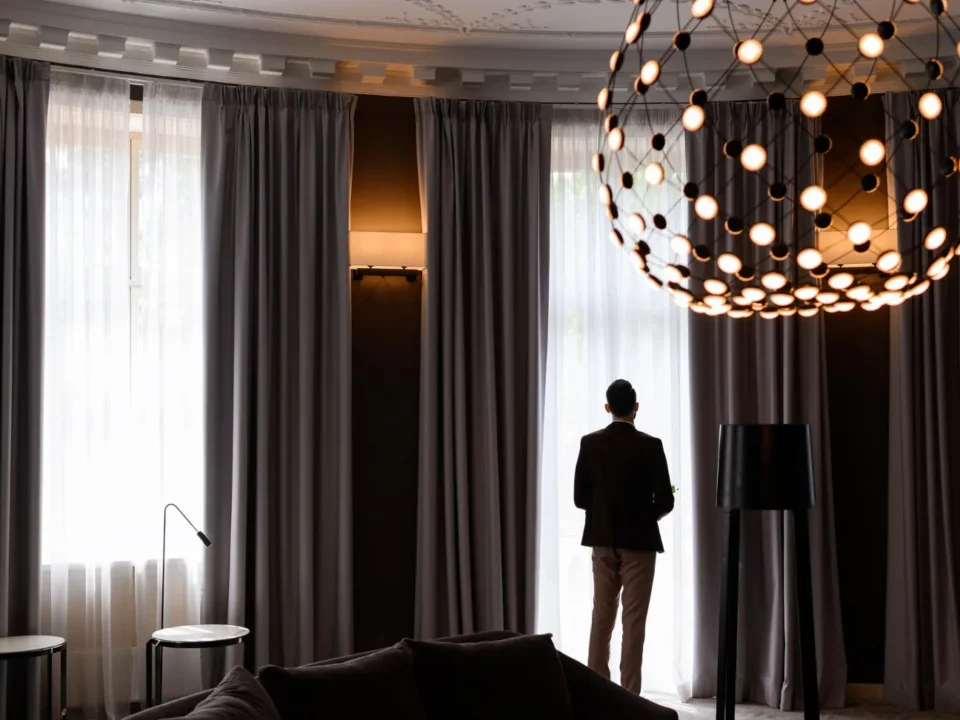
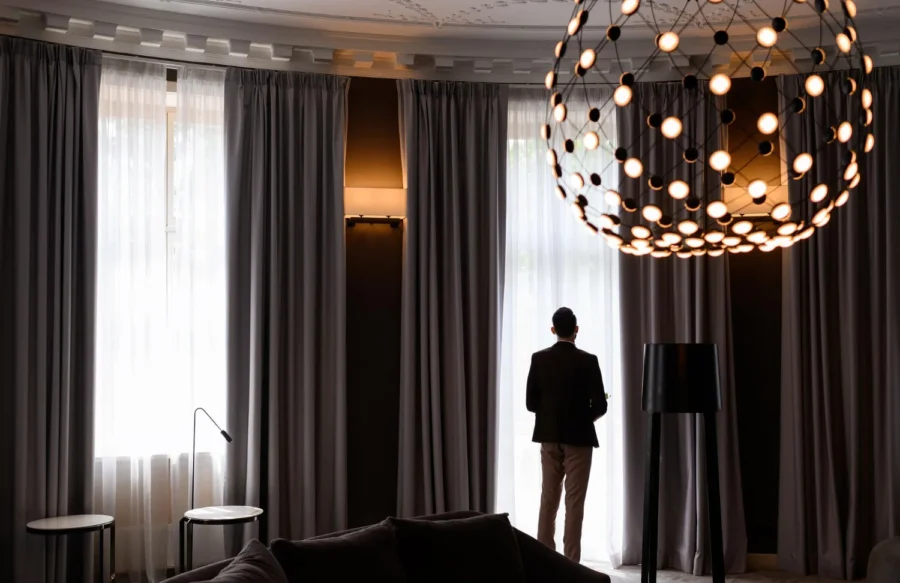
Another strong trend is sculpturality. Not in the sense of pretentious gallery pieces, but in the fact that the body of the lamp has a presence even when it is turned off. Shape, volume, and mass are no longer secondary. The lamp stands in the space as an object with character, not as a technical addition to the ceiling or wall.
This is an important change. For years, lighting was hidden, with built-in solutions and “clean lines”. Today, it is consciously brought out. And not because it wants to attract attention, but because it has been realized that a space without visible elements has no anchor. Light becomes that anchor.
Another clear direction is the return to warmth. Not only in color temperature, but in the entire lighting concept. Instead of one perfectly calculated lighting of a space, we are increasingly working with layers. Ambient, working, accent. Light that changes throughout the day and that does not insist on maximum visibility at all times.
Houzz talks about “comfortable light” here, but it’s more realistic to say that it’s about acknowledging human fatigue. The space is no longer a showroom, but a place to stay. The lighting has to follow suit.
Custom thinking without the “custom” label
Perhaps the most interesting trend is the one that is not directly named. Modularity, customization, the ability to choose dimensions, colors, materials, or installation methods. All of this is becoming expected, not a luxury. We don’t necessarily talk about bespoke lighting, but we act as if it is the normal state.
It is a silent but profound change. Standard solutions can no longer respond to the diversity of spaces and lifestyles. Lighting must follow architecture, not the other way around. And here the line between design and manufacturing is blurred.
The trends for 2026 do not bring shocking novelties, but rather consolidation. Lighting becomes more mature. Prove less, serve more. It uses less technology, more builds atmosphere. And perhaps most importantly, it reconnects with a person, not a catalog.
If it had to be reduced to one sentence, it would be this: a lighting fixture is no longer the answer to the question “how to light a space”, but to the question “what kind of space do we want to live in”.
We are happy to answer all your questions!
Use the form below and ask anything you want to know.
If you need an official offer, choose: company